
The Art of the Brag: How to Document Your Wins So Promotions Aren’t a Guessing Game
Because hard work doesn’t speak for itself — you do.
Let me tell you something I learned the hard way: nobody is keeping score of your wins but you. Not your manager. Not HR. Not the universe. You can be the hardest-working woman in the building, and if you can’t articulate what you’ve done when promotion season rolls around, somebody louder is going to walk away with what should’ve been yours.
I know because it happened to me. I got passed over for a PM role I knew I could do. And one of the things that humbled me real quick was realizing I couldn’t even rattle off my own wins in the moment. I had done the work — I just hadn’t documented it. Chile, never again.
So let’s talk about the art of the brag — the mindset shift and the system. Because you need both.
First, the Mindset: Bragging Isn’t Bragging
Somewhere along the way, women — especially women of color — got taught that talking about our accomplishments is tacky. Unprofessional. “Too much.” Meanwhile, the guy two cubicles over is sending a company-wide email every time he answers a Slack message.
Here’s the reframe: documenting your wins isn’t bragging. It’s receipts. It’s reporting. It’s the same thing your company does every quarter when they tell shareholders how well they performed. You are the CEO of your career, and you owe yourself an annual report.
When you start seeing your wins as data instead of self-promotion, the whole thing gets easier. You’re not showing off. You’re showing up with proof.
The System: Your Brag Doc
Open a new doc right now. Title it whatever you want — “Wins,” “Brag Book,” “Receipts,” the choice is yours. Mine is literally called “Don’t Forget What You’ve Done.” Save it somewhere personal (not your work drive — you’ll want this when you switch jobs). Then build it out with these sections:
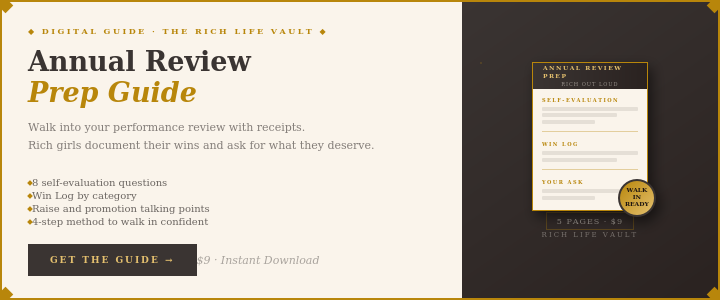
1. The big wins. Projects you led, problems you solved, things that wouldn’t have happened without you. Be specific. “Led the implementation” means nothing. “Led the implementation of [system] for [client], delivered two weeks ahead of schedule, saved the team an estimated 15 hours/week” — now we’re cooking.
2. The numbers. Anytime you can attach a number, do it. Time saved. Money saved. Errors reduced. People trained. Tickets closed. Clients onboarded. Revenue influenced. If you can’t find a number, ask yourself: what would have happened if I hadn’t done this? That’s often where the metric is hiding.
3. The compliments. Every time someone says something nice in writing — a “thank you so much,” a “you saved us,” a “this is exactly what we needed” — screenshot it or copy it in. Note who said it and when. These are gold during reviews.
4. The stretch. Anything you did that was outside your job description. Trained a new hire. Stepped in for your manager. Volunteered for the cross-functional project nobody wanted. This is the evidence that you’re already operating at the next level — which is exactly what they’ll ask for when you go up for the promotion.
5. The growth. Courses you took, certifications you earned, books you read, skills you sharpened. Show that you’re investing in yourself — because they’re going to want to invest in someone who already is.
The Cadence: Update It Like a Bill
Here’s where most people fall off. They start the doc, fill it in for two weeks, and then forget it exists until somebody mentions promotions. Don’t do that.
Update your brag doc every Friday. Just five minutes. What did I do this week that mattered? Who said something nice? What number can I capture? Treat it like a recurring bill — it gets paid, no exceptions. By the end of the year, you’ll have 50+ entries instead of trying to remember what you did in February while staring at your screen in October.
How to Actually Use It
A brag doc that lives in a folder you never open isn’t doing anything for you. Here’s when to pull it out:
• Performance reviews. Don’t walk in and try to remember. Walk in with a one-page summary built from your doc.
• 1:1s with your manager. Reference recent wins casually — “After we wrapped the [project] rollout last month” — to keep them top of mind.
• Promotion conversations. When you ask for the title or the raise, you don’t plead. You present. The doc is your evidence.
• Resume and LinkedIn updates. Pull straight from your wins and metrics. No more staring at a blank page trying to remember 2023.
• Job interviews. Every behavioral question becomes easier when you’ve been collecting stories all along.
One More Thing
The brag doc isn’t just a career tool. It’s a confidence tool. There will be weeks you feel like you’re not doing enough, like you’re falling behind, like you should be further along. Open the doc on those days. Read what past-you accomplished. Remind yourself that you are, in fact, that girl.
Your career is too important to leave to memory. Your wins are too real to go undocumented. And you are too good to let somebody else tell your story.
So start the doc. Update it Friday. Use it like a strategist. And the next time promotion season rolls around, you won’t be hoping somebody noticed — you’ll have the receipts to prove they should’ve.
Now go live your richest life — and document the whole thing. 💋
-Tiah
